
Introduction
Most research sites don't fail to grow because of a lack of demand.
They fail to grow because growth feels operationally unsafe.
Every new study brings the same internal questions:
Do we actually have the capacity?
What breaks if enrollment ramps faster than expected?
How many full-time hires does this really require?
And what happens if the study pauses or underperforms?
Those questions are not pessimistic. They're rational. Clinical research volume is variable by nature, yet most sites are built on rigid staffing assumptions. That mismatch is what keeps capable sites small, not performance or opportunity.
The Fear Behind the "Yes"
When sponsors send feasibility questionnaires, the real evaluation often isn't scientific, it's operational.
Can we absorb this work without:
Burning out the existing team
Making permanent hires we can't unwind
Creating downstream quality or compliance risk
For many smaller private sites scaling up, the honest answer is "maybe," which often turns into "no" by default. Not because the site isn't qualified, but because saying yes feels like stepping onto a treadmill that won't stop and leadership are rightfully concerned about employee burnout.
This is where opportunities are lost, revenue is missed and growth stalls.
Why Traditional Growth Models Break Down
The default growth playbook is simple:
- More studies → more staff → more overhead
This model assumes:
Study volume will remain stable
Enrollment timelines will be predictable
Staff utilization will stay high
And long-term payroll commitments are safe bets
In reality, none of those assumptions reliably hold.
Enrollment surges and stalls. Protocols change. Sponsors delay decisions and change timelines. Entire programs can pause with little warning or get swamped with last minute interim data base locks. Yet full-time staff costs remain fixed, regardless of workload.
Over time, sites internalize this risk. They become conservative, not because they lack confidence, but because they've learned the cost of getting it wrong.
Reframing the Problem: Capacity ≠ Headcount
High-performing sites that scale sustainably don't solve growth by hiring faster.
They solve it by decoupling leadership from execution.
Instead of expanding vertically, adding full teams for every incremental study, they expand horizontally by creating a hybrid operational structure:
A core leadership layer that remains stable
A flexible execution layer that scales up and down with demand
This is not about outsourcing control. It's about designing for variability and more importantly, designing for growth.
The Hybrid Organizational Model
At its core, the hybrid organizational model separates decision-making from execution. Instead of scaling by adding full, vertically integrated teams for every new study, sites keep leadership, oversight, and accountability fixed, while allowing execution capacity to flex with demand. This preserves control where it matters most: study selection, regulatory responsibility, quality standards, and financial risk. Growth no longer requires committing to permanent overhead before the work actually exists. In practice, this means building around a stable leadership core that defines how work is done, supported by an on-demand execution layer that expands and contracts as studies enter and exit the pipeline. The site remains the operator, not a coordinator of chaos. Capacity is added intentionally, under existing processes, without forcing leadership to choose between burnout and overhiring. The result is an organization designed for variability, able to say “yes” to opportunity without destabilizing the system. The structure below illustrates how leadership remains fixed while execution capacity flexes beneath it.
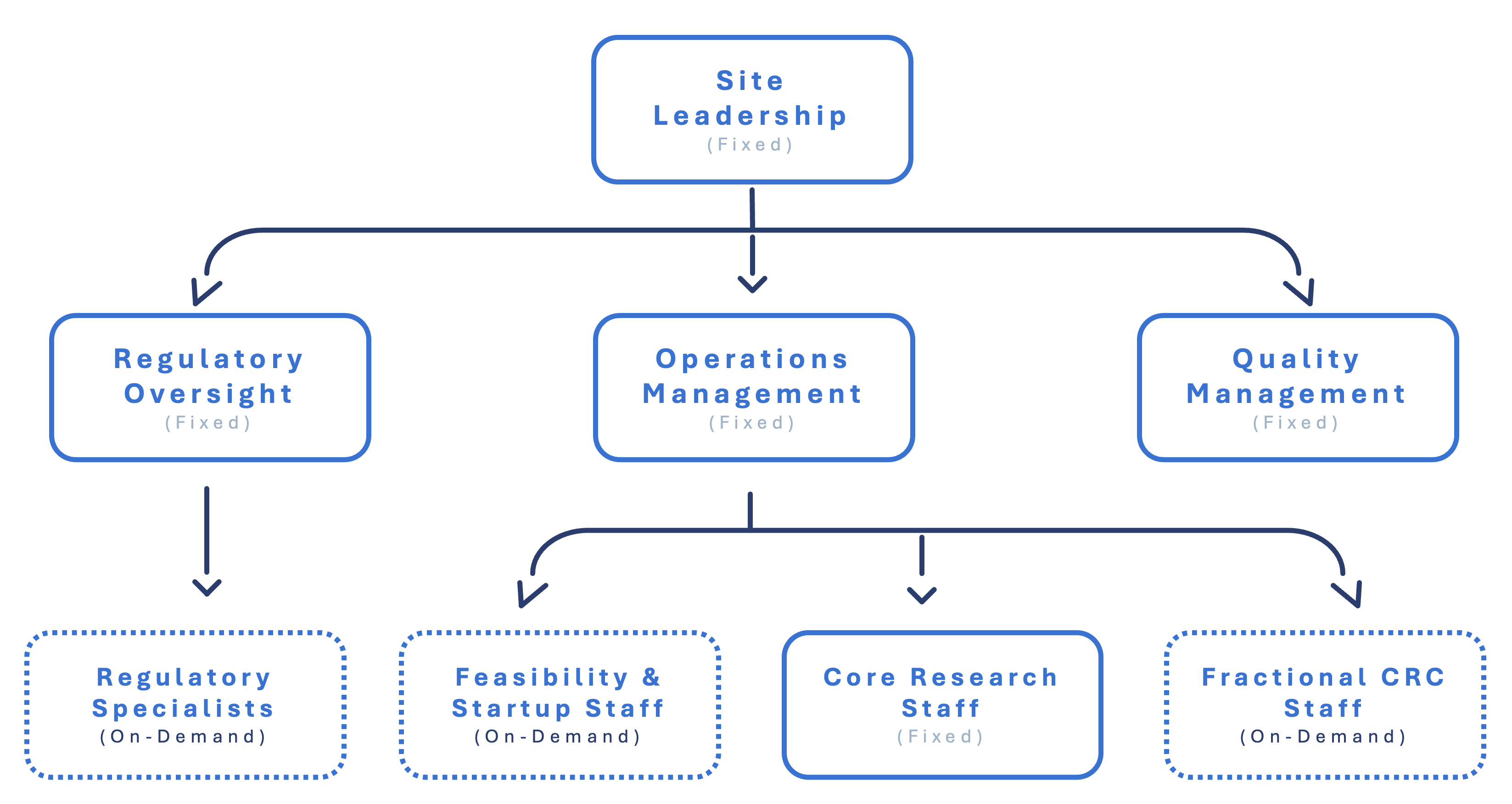
Core Full-Time Leadership (Fixed):
Principal Investigator(s)
Site Director / Operations Lead
Regulatory and quality oversight
Financial and strategic decision-makers
This group defines:
Which studies to accept
How work is performed
What standards must be met
Where accountability lives
Execution Layer (Variable):
Study startup support
Feasibility response preparation
Regulatory document execution
Enrollment and data-related execution tasks
Study closeout or surge-period support
This layer expands when workload increases and contracts when it doesn't, without destabilizing the organization.
The result is a site that can grow without converting every opportunity into a permanent cost.
Why This Model Changes Feasibility Dynamics
Feasibility questionnaires are often treated as administrative hurdles. In reality, they're strategic choke points.
Under a rigid staffing model, feasibility triggers anxiety:
"If we say yes, who does the work?"
"Are we setting ourselves up to fail?"
Under a hybrid model, feasibility becomes a filtering exercise:
Is this a good operational fit?
Does the timeline align?
Does the study justify the resources?
The difference is subtle but important.
Instead of capacity determining opportunity, opportunity determines capacity.
That shift alone allows sites to respond faster, say yes more confidently, and compete more effectively, without putting the core team at risk.
Scaling Without Losing Control
One common concern is that flexible execution leads to fragmented operations or diluted standards.
That only happens when leadership abdicates ownership.
In a properly designed hybrid model:
Leadership sets the processes
Execution staff operate within those processes
Accountability flows upward, not outward
Your site doesn't become dependent on external decision-makers. It becomes less dependent on overworked internal staff.
Quality improves because:
Work is assigned intentionally
Surge periods don't force shortcuts
Leadership has bandwidth to oversee outcomes, not just tasks
The Hidden Benefit: Leadership Focus
Perhaps the most overlooked advantage of the hybrid model is what it gives back to leadership.
When your core team isn't stretched thin by execution, they can focus on:
Sponsor relationships
Process optimization
Standardization across studies
Long-term growth strategy
Financial and operational forecasting
These are the activities that actually scale an organization. Not doing more work but designing better systems.
Sites that grow successfully aren't busier. They're clearer.
From a Single Site to a Networked Operation
Once execution capacity is flexible, the definition of "site" begins to change.
You stop thinking in terms of:
One physical location
One fixed team
One maximum workload
And start thinking in terms of:
A leadership hub
A standardized operating model
A scalable execution network
This is how sites expand into additional therapeutic areas, take on parallel studies, or explore satellite locations, without duplicating overhead at every step.
Growth becomes additive instead of exponential in cost.
Where Clinolink Fits In
Clinolink was built to support this exact operational shift.
Instead of forcing sites to choose between overextending staff or overhiring, Clinolink provides access to execution capacity that aligns with your workflows, under your leadership, and on your terms.
You keep control.
You maintain standards.
You scale when it makes sense, and pause when it doesn't.
This turns growth into a strategic decision rather than a financial gamble.